

Alocasia Plant Guide to Types, Care, and What to Expect
Oct 24, 2026
In the wild, an Alocasia leaf can grow big enough to hold over your head like an umbrella in a rainstorm. An Alocasia is a tropical plant grown mainly for its leaves, not its flowers, and those leaves come in arrow, heart, and shield shapes with veining that can look painted on. The genus includes close to 100 species, plus hundreds of hybrids bred for pattern, color, and leaf texture rather than size. Most of the ones sold for homes stay compact enough for a side table or a plant stand, even though their wild relatives can tower several feet tall.
Picking the right Alocasia means matching a specific type to your light, space, and daily habits, since care needs shift quite a bit across the genus. Some, like Alocasia ‘Venom’ with its near-black, textured foliage, want bright indirect light and steady humidity to keep their color deep. Others, like the quilted, metallic-looking leaves on Alocasia sinuata ‘Quilted Dreams’, stay more compact and forgive a little more inconsistency in watering. A few types, including Alocasia ‘White Dragon’ with its bold white veins, need a bit more attention to soil drainage to avoid root rot. Knowing the type in front of you is the real starting point for keeping it alive past the first few months.
Table of Contents
What Exactly Is an Alocasia Plant
Alocasia is a genus of about 90 tropical species, native to rainforests across Asia and Australia. Botanists sort them under the aroid family, the same broad group that includes Philodendron and Monstera, but Alocasia stands apart in how its leaves sit and grow.
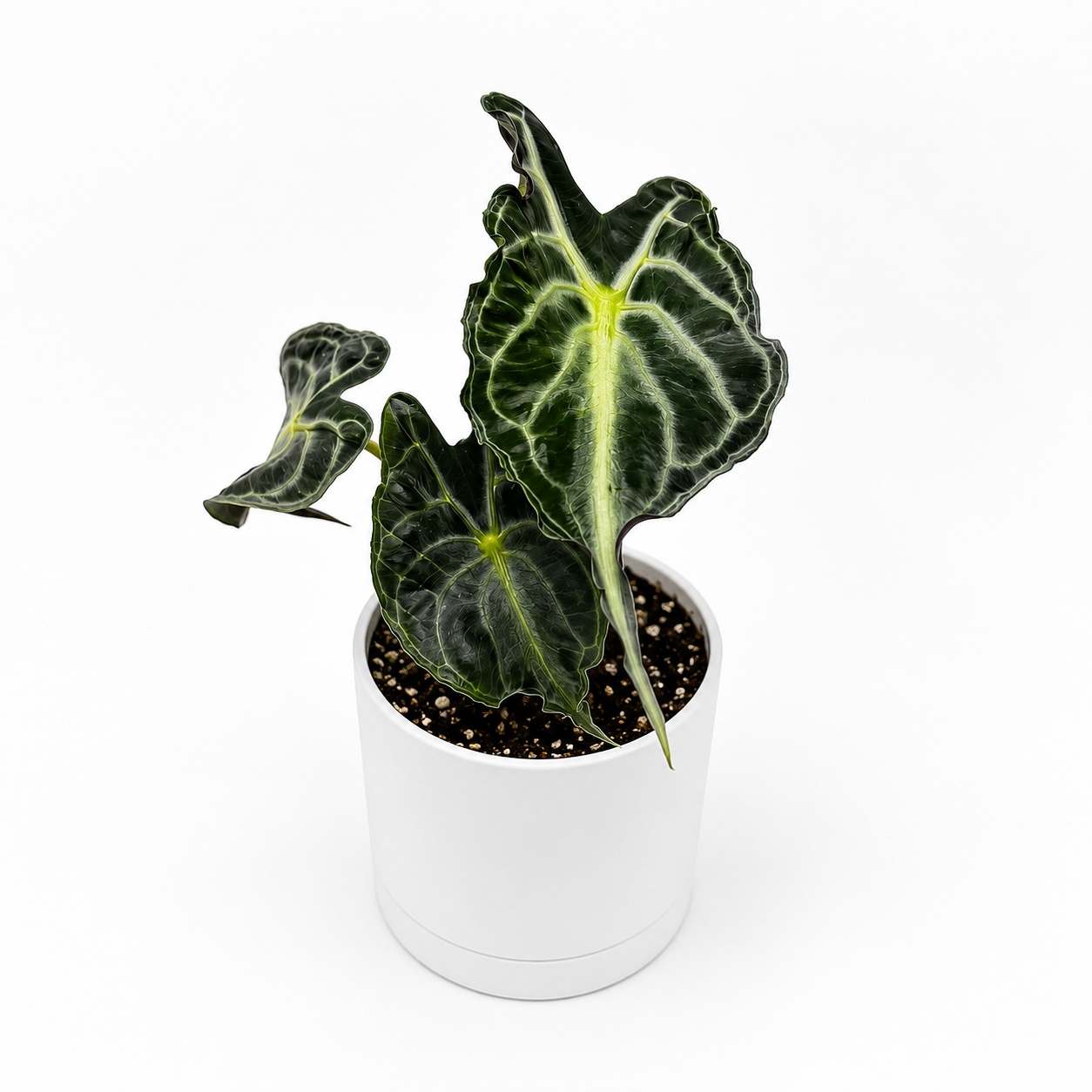
Alocasia 'Venom'
The nickname "Elephant Ear" comes from the wide, arrow or heart-shaped leaves that fan out on long stalks. That nickname gets shared with Colocasia, which causes mix-ups at the garden center, so the leaf direction is the fastest way to tell them apart.
Alocasia leaves point up and outward from a central rhizome, a thick underground stem that stores energy and sends up new growth over time. Prominent veining runs across each leaf, often in a contrasting color, which is part of what makes types like Alocasia 'White Dragon' easy to spot in a room full of houseplants.
| Feature | Alocasia | Colocasia |
|---|---|---|
| Leaf direction | Points upward | Points downward |
| Leaf surface | Glossy to matte, firm | Softer, often waxy |
| Growth habit | Rhizome, upright clumps | Tuber, spreading mats |
Philodendron, by contrast, usually trails or climbs instead of forming an upright rosette, and its leaves don't carry the same raised vein pattern. Once you can spot leaf direction and texture, sorting an Alocasia from its tropical look-alikes on a shop shelf gets a lot faster.
Picking the Alocasia Type That Fits Your Space
The right Alocasia type depends on how much floor space, light, and attention you can give it, not just which leaf pattern catches your eye. Alocasia 'Venom' has near-black, reptilian-textured leaves and stays small enough for a shelf or a desk in a home office. Alocasia sinuata 'Quilted Dreams' shows deeply ridged, almost metallic foliage and fits well in a small apartment where floor space is tight. Alocasia 'White Dragon' carries dark green leaves with bold white veins for a hand-drawn look, though it wants more careful drainage than the other two.
| Type | Mature Size | Leaf Pattern | Price |
|---|---|---|---|
| Venom | Compact, under 2 ft | Near-black, textured | $49.80 |
| Quilted Dreams | Compact, under 18 in | Quilted, metallic green | $39.00 |
| White Dragon | Medium, up to 3 ft | Dark green, white veins | $54.68 |
Mature size matters more than the photo on the tag, since a plant that looks small in a pot can still need floor space within a year or two. Compact types like Venom and Quilted Dreams work on desks, bookshelves, and narrow windowsills, while larger growers like White Dragon need a dedicated spot on the floor. You can browse the full range of Alocasia varieties to compare leaf shape and size before deciding what fits your room.
Light and Water Needs That Keep Leaves Healthy
Alocasia plants do best in bright, indirect light, the kind you get a few feet back from an east or north-facing window. Direct sun scorches the leaves within days, leaving crispy brown patches, while too little light causes thin, leggy stems as the plant stretches toward any source it can find. Water only when the top two inches of soil feel dry to the touch, then soak the pot until water runs out the drainage holes. Overwatering is the most common cause of Alocasia dieback, usually showing up as yellow leaves and a mushy stem base.
- Check soil moisture with a finger, not a calendar, since light and pot size change how fast it dries
- Use a pot with drainage holes every time, no exceptions
- Rotate the pot a quarter turn weekly so growth doesn't lean toward the window
- Wipe leaves with a damp cloth monthly to keep pores clear for better light absorption
Humidity and Temperature for Jungle-Like Growth
Alocasia plants come from rainforest understories, so they expect humidity at 60% or higher to keep their leaves full and glossy. Dry apartment air, especially during winter heating or summer air conditioning, pulls moisture from the leaf edges and leaves them brown and crisp. Keep the room between 65 and 80°F and keep the plant away from cold drafts, heating vents, and air conditioner blasts, all of which stress the leaves fast. A few simple setups can close the humidity gap without turning your living room into a greenhouse.
- Run a small humidifier near the plant, especially in winter
- Set the pot on a pebble tray filled with water so it doesn't sit in standing water directly
- Group it with other tropical plants to raise the humidity in that corner of the room
- Skip bathroom placement unless the window there gets bright, indirect light too
Feeding, Repotting, and Signs of Dormancy
Alocasia plants need monthly feeding during spring and summer with a liquid fertilizer diluted to half strength, since full-strength doses can burn the roots. Repot every one to two years, or sooner if roots start circling the bottom of the pot or growth stalls out completely. Many Alocasia types drop leaves and go dormant in winter, which looks alarming but is a normal rest period, not a dying plant. Cut back watering during dormancy and wait for new growth before resuming a regular schedule, since watering a dormant rhizome the same as an active one invites rot.
- Feed monthly from spring through summer, skip fall and winter entirely
- Repot when you see roots at the drainage holes or growth slows for no clear reason
- Expect some leaf drop in winter as the plant conserves energy in its rhizome
- Hold off on fertilizer and heavy watering until you see a new leaf unfurling
Patience or Constant Fussing, Pick One
A new Alocasia leaf rarely looks like the finished product on day one. It unrolls small, pale, and sometimes almost translucent, then thickens up and darkens into its real color and texture over a few weeks. If you judge the plant by that first unfurled leaf, you'll think something is wrong when nothing is.
Collectors who pay more for a type like Alocasia 'Venom' or Alocasia 'White Dragon' aren't paying for a bigger plant. They're paying for a specific leaf pattern, like near-black texture or crisp white veining, that takes a full growth cycle to show itself clearly. A plant with simpler, more common leaf patterns usually costs less even at the same pot size.
| Approach | What it costs you | Who it fits |
|---|---|---|
| Wait out each new leaf | A few weeks of uncertainty per leaf | First-time owners building confidence |
| Adjust light or water at every pale leaf | Root stress from overcorrection | No one, this usually backfires |
| Track growth monthly instead of daily | Slower feedback, less panic | Busy owners with home offices or tight schedules |
Checking a plant every day and changing its spot or watering routine each time a leaf looks off almost always does more harm than the pale leaf itself. A monthly check, paired with the care basics in the Alocasia care guide, tells you more than daily worry ever will.
Which Alocasia Type Goes Home With You
Measure the actual spot first: a desk or shelf calls for Venom or Quilted Dreams, a floor corner with room to spread fits White Dragon. Set your watering and light routine before the plant arrives, not after, so the first few weeks don't turn into guesswork. Bright, indirect light and a finger check on soil moisture, done the same way every time, matter more than which type you pick. Runo Plants ships Venom, Quilted Dreams, and White Dragon ready to settle into a new home, so the only real decision left is which leaf pattern and size match the room you already have.
Alocasia Questions People Still Ask
Are Alocasia plants toxic to cats and dogs?
Yes, every Alocasia type is toxic to cats and dogs if chewed or swallowed. The leaves and stems contain calcium oxalate crystals, which cause mouth swelling, drooling, and vomiting. Keep the pot up on a shelf or stand out of reach rather than on the floor, especially with a curious cat that likes to chew leaves.
Why do Alocasia leaves sometimes drip water on their own?
That dripping is called guttation, and it happens when the roots push up more water than the leaves can use through their pores overnight. It shows up most on healthy, well-watered plants in high humidity, usually as small beads at the leaf tips in the morning. It is not a sign of damage or disease, just the plant releasing excess moisture.
Can I keep an Alocasia in a bathroom with a window?
Yes, a bathroom with a bright, indirect light window actually works well for Alocasia because of the natural humidity from showers. A small, windowless bathroom will not supply enough light, even with the extra moisture in the air. Match the light level first, then let the humidity be a bonus rather than the main reason for the spot.
How do I know if my Alocasia is just resting or actually dying?
A resting Alocasia drops leaves slowly, one or two at a time, while the rhizome underground stays firm and the remaining leaves still look normal. A dying plant usually shows a soft, mushy stem base, a sour smell at the soil line, or several leaves collapsing all at once. If you catch mushiness early, pulling the plant to check the roots tells you more than watching the leaves alone, and Runo Plants can walk you through what healthy roots should look like if you reach out.